
Cybersecurity Awareness Month is over: five lessons from October 2026
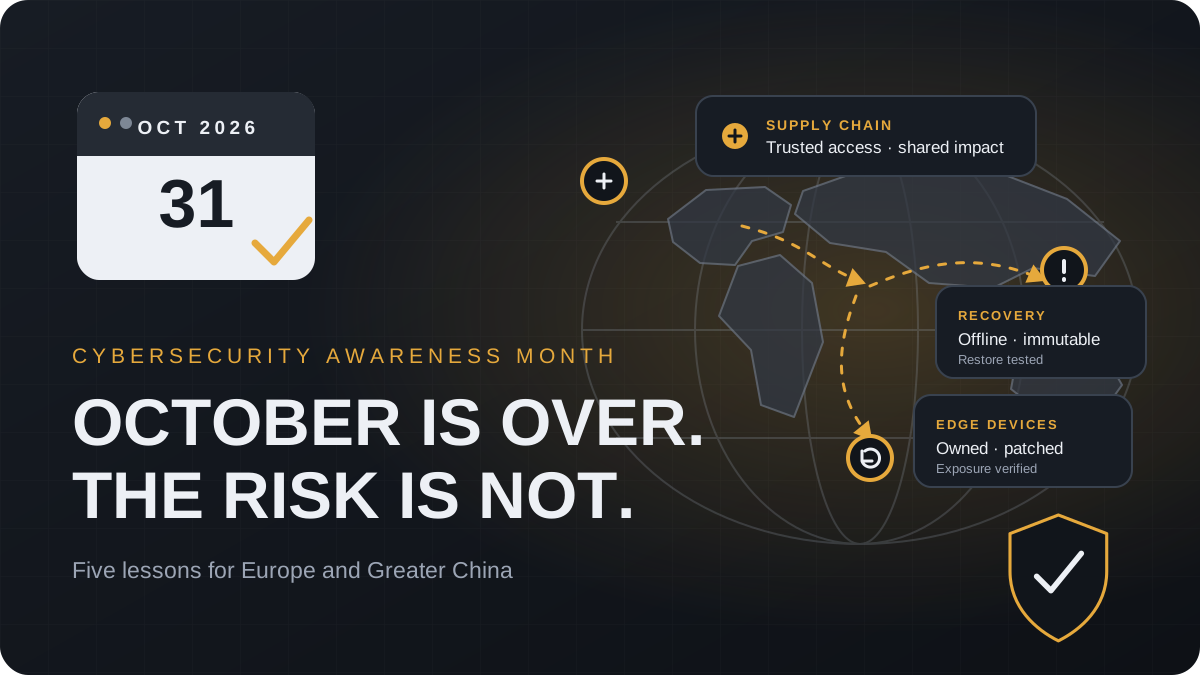
Cybersecurity Awareness Month has ended. The attacks have not.
October 2026 brought an unusually visible concentration of ransomware, supply-chain compromises, exposed infrastructure and large data incidents across Europe and Asia-Pacific. One monitoring dataset recorded 1,127 organisations named on ransomware leak sites during the month, 25.8% more than in September.
That figure needs context. A leak-site listing is a criminal claim, not independent proof that every organisation was compromised exactly as alleged. Different trackers also produce different totals. But the direction is difficult to ignore: extortion activity remained intense while several incidents demonstrated how quickly a technical weakness can become an operational, financial or regulatory problem.
At the largest end of the scale, Binance estimated that approximately $6.3 billion in cryptoassets was stolen on 29 October. The FBI attributed the attack to North Korea's TraderTraitor activity. Most companies will never face an incident of that size, but the same underlying questions apply to a regional office, factory or mid-sized subsidiary: which access can move money, stop operations, expose data or erase the recovery path?
The useful lesson from October is not that every company should prepare for the most expensive cyber heist in history. It is that ordinary weaknesses repeatedly created extraordinary consequences.
Europe: cyber incidents moved beyond the screen
In France, attackers manipulated connected refrigeration controllers used by hundreds of supermarkets. Temperatures rose, food had to be discarded and some stores reported fires. A remote-management function became a direct operational loss.
This incident deserves attention well beyond retail. Factories, warehouses, hotels, laboratories and office buildings all depend on connected equipment that may have been installed by a vendor, exposed for remote maintenance and left outside the normal IT inventory. We examine the operational lessons in more detail in When hackers turn off the fridges.
The same month, the Hauts-de-France regional authority disclosed unauthorised access to personal information processed by two service providers, Atexo and Docaposte. Public statements put the confirmed population affected at approximately 545,000, while the attacker claimed more than 700,000 records. The precise total matters to the investigation, but the management lesson is already clear: outsourcing a system does not outsource the consequences of losing the data inside it.
OVHcloud then disclosed a different kind of supply-chain incident. A compromised developer account was used to replace downloadable binaries attached to five existing releases of the official OVHcloud command-line tool. The malicious files were available for roughly 94 minutes.
That was a short window, but it challenged a common assumption: downloading a tool from an official release page is not by itself proof that the file is trustworthy. Release immutability, protected maintainer accounts, independently verified hashes and controlled software distribution all matter.
Greater China and APAC: old systems and trusted suppliers remained decisive
The Asia-Pacific incidents were different in detail but similar in structure.
Unpatched NAS devices became ransomware targets
Synology warned that attackers were exploiting a vulnerability already patched in December 2024 to target NAS devices running outdated versions of DiskStation Manager. A NAS is often treated as a dependable box in the corner rather than a server that needs ownership, patching, restricted access and monitoring.
It may also contain the backup. If ransomware can reach both production data and the only backup copy through the same device or credentials, the organisation has storage, not a resilient recovery plan.
A backdoored video player reached more than 700,000 devices
China's National Computer Network Emergency Response Technical Team/Coordination Center (CNCERT/CC) warned that the Windows version of JianPian Player contained backdoor functionality. The software could collect device information, download and run additional programs, and execute remote instructions.
CNCERT/CC reported 700,260 infected devices in China between 15 and 22 September, with more than 250,000 controlled devices online at the daily peak. The warning was published in October. The episode is a reminder that “free software” and unmanaged utilities can create a large, unapproved route into company endpoints.
Cloud dependency did not remove recovery responsibility
In Japan, a ransomware attack disrupted part of IDCF Cloud's East Japan Region 1. IDC Frontier said the incident affected 495 corporate and municipal customers. The provider worked with customers on alternative environments and recovery, but the event exposed a practical continuity question: can the customer rebuild critical services somewhere else when the primary cloud environment and its normal recovery path are both unavailable?
“In the cloud” does not automatically mean “recoverable”. The customer still needs an independent understanding of configurations, identities, data copies, restoration priorities and acceptable downtime.
Large customer datasets remained attractive targets
Ryohin Keikaku, the company behind MUJI, announced possible unauthorised access to information associated with up to 27.26 million MUJI app users, including former users. Cathay Pacific separately disclosed that unauthorised access at travel technology provider Amadeus affected about 53,000 bookings. In most Cathay records, the exposed information included the passenger name, booking reference and flight details.
Neither case can be reduced to “the supplier's problem” or “the application's problem”. Customers associate the incident with the brand they trusted. Regulators and business partners will also ask what data was shared, why it was necessary, how the supplier was assessed and how the organisation responded.
Five patterns behind the headlines
The incidents look unrelated until they are viewed as management problems.
1. Your suppliers are part of your perimeter
The Hauts-de-France and Cathay incidents involved data handled by service providers. The OVHcloud incident involved a trusted software distribution channel. IDCF Cloud affected hundreds of organisations through a shared infrastructure dependency.
Supplier risk management therefore cannot end with a questionnaire before contract signature. A company needs to know:
- what the supplier can access;
- which data and systems depend on it;
- how privileged accounts are protected;
- how incidents must be reported;
- what evidence of security and recovery is available; and
- how the business will continue if the supplier is unavailable.
2. A patch released months ago can still be an open door
Synology's warning concerned devices that had not received an older fix. Palo Alto Networks also reported continuing exploitation attempts against CVE-2026-0257, a GlobalProtect authentication-bypass vulnerability patched in May, including activity associated with Qilin and INC ransomware operators.
The relevant metric is not “patch released”. It is “affected asset identified, updated and verified”. Edge systems deserve priority because they are reachable from outside and often provide a direct path into the network.
3. Forgotten infrastructure is often the easiest infrastructure to attack
NAS appliances, VPN gateways, remote-support tools, refrigeration controllers and small utilities are easy to exclude from the main server inventory. They may have no clear owner even though they hold data or provide privileged access.
An asset without an owner rarely has a reliable update process, access review, monitoring rule or recovery plan.
4. A reachable backup is not enough
A backup must survive the incident it is intended to recover from. That usually means at least one copy that cannot be modified through the same credentials and administration path as production.
Offline, immutable or separately administered copies are useful only if the company also tests restoration. A successful backup job proves that data was written; a restore test proves that the business can use it.
5. Compliance gaps become more expensive after the incident
For companies operating in China, cybersecurity and compliance cannot be managed as separate projects. PIPL requires appropriate protection of personal information and a controlled response when information is compromised. MLPS obligations bring security management, technical controls, assessment and remediation into the same operational picture.
An unidentified overseas access path, unmanaged supplier, unsupported device or untested recovery process is cheaper to address during an audit than during an incident, when management is also handling downtime, notification, evidence and reputational pressure.
Five urgent vulnerability checks
October also produced a patching list that deserves immediate attention. This is not a ranking of every vulnerability affecting every company. It is a practical check for commonly exposed or high-impact technology.
1. PHP2Shell: update the PHP runtime itself
The PHP project released fixes for CVE-2026-109618 and CVE-2026-109619, two critical issues that can allow unauthenticated remote code execution before normal application logic can protect the request. PHP stated that there is no complete mitigation other than updating.
Supported fixed releases are PHP 8.5.12, 8.4.27, 8.3.36 and 8.2.35. Check web servers, containers, appliances and older business applications that bundle PHP without making the runtime visible to normal inventory tools. Restart the relevant workers after updating and verify the effective version, not only the package manifest.
2. Synology DSM: update and remove unnecessary internet exposure
Confirm every Synology device, its DSM build and whether its administration interface is reachable from the internet. Apply the vendor's current update, disable unused accounts and services, require multi-factor authentication, and place remote access behind a controlled VPN or equivalent secure-access layer.
Then verify that a separate recovery copy exists outside the NAS administration boundary.
3. Palo Alto GlobalProtect: confirm the May fix was actually deployed
CVE-2026-0257 allows an attacker to bypass authentication restrictions and establish an unauthorised VPN connection on affected PAN-OS GlobalProtect portals and gateways. Palo Alto Networks published fixes in May, but ransomware-linked exploitation continued to be observed months later.
Confirm the running PAN-OS version on every gateway and review GlobalProtect logs for the indicators and connection patterns in the vendor guidance. Do not assume that a change ticket proves every appliance was updated.
4. BeyondTrust Remote Support: apply BT26-05
CVE-2026-102764 affects BeyondTrust Remote Support 26.2.3 and earlier unless the BT26-05 patch has been applied. The vendor rates it critical at CVSS v4 9.3 and says it can allow a remote attacker to perform file operations on the appliance. CISA added the vulnerability to its Known Exploited Vulnerabilities catalogue.
Remote-support infrastructure is especially sensitive because it is designed to reach other systems. Patch it, restrict who can administer it and review the appliance for unexpected changes.
5. GitLab: update self-managed installations
GitLab fixed CVE-2026-97229 in versions 19.4.2, 19.3.5 and 19.2.8. Under certain conditions, an unauthenticated user could execute code on the server through a crafted regular expression in CI/CD configuration.
Update every self-managed instance and runner environment in scope. Because source code, deployment credentials and build pipelines converge in GitLab, compromise can become a software-supply-chain incident rather than an isolated server event.
What management should do this week
A useful response does not begin with buying another tool. Begin with a short, evidence-based review:
- List internet-facing and remotely managed assets. Include VPNs, NAS devices, remote support, cloud consoles, operational controllers and vendor-installed tools.
- Check the five urgent technologies above. Record the owner, effective version, exposure, patch status and verification evidence.
- Identify critical suppliers and privileged access. Confirm what each supplier can reach and how the business would operate without it.
- Prove one important restore. Recover a representative system or dataset from a copy that the normal production administrator cannot overwrite.
- Close the governance loop. Give every gap an owner and date, and connect the technical action to the company's PIPL, MLPS and incident-response obligations.
This is also the right moment to ask whether staff know how to escalate a suspicious request, unexpected software installation or supplier warning. Awareness training is most effective when it connects everyday decisions to technical controls and a clear reporting path.
Awareness month should produce evidence, not slogans
October's incidents did not share one attacker, one industry or one vulnerability. They shared a failure to control a dependency before it became urgent: an exposed controller, an old patch, a trusted supplier, an official download, a cloud recovery path or a backup that was too reachable.
Cybersecurity Awareness Month is useful if it creates habits that continue in November: inventory what matters, patch what is exposed, verify suppliers, isolate recovery copies and practise the response.
APIS Consulting helps international companies operating in China turn those actions into a practical programme. We can assess your exposure, harden internet-facing and remote-access systems, review supplier and backup controls, support PIPL and MLPS readiness, and deliver focused awareness training for management and staff.
Contact us to discuss a focused security review, or begin with our information-system audit.
Sources
- Original LinkedIn post by Antoine Pilarczyk
- HackerFeeds: ransomware leak-site claims in October 2026
- FBI: North Korea responsible for the Binance attack
- CERT-FR: compromises affecting connected refrigeration systems
- OVHcloud CLI security advisory
- Synology: ransomware attacks targeting outdated DSM versions
- CNCERT/CC warning on the backdoored JianPian Player
- IDC Frontier investigation and recovery update
- Ryohin Keikaku notice concerning the MUJI app
- Cathay Pacific notice concerning its third-party service provider
- PHP project: critical remote-code-execution security releases
- Palo Alto Networks Unit 42: active exploitation of CVE-2026-0257
- BeyondTrust security advisory BT26-05
- GitLab critical patch release for CVE-2026-97229
This article reflects public information available on 2 November 2026. Incident investigations and vendor guidance may change. Verify current advisories before taking technical action.